

Quality Assurance vs. Quality Control: QA and QC Explained
Quality assurance (QA) and quality control (QC) both support digital quality, but they operate at different stages. QA focuses on preventing defects through process design and standards, while QC focuses on identifying defects in the finished product through testing and inspection.
Digital experiences now touch nearly every part of business, from payments to insurance documentation to retail shopping. That makes digital quality a direct driver of user retention, customer loyalty and revenue. Below, we break down what separates QA and QC, where they overlap and how organizations use both to deliver reliable digital products.
Reports
State of Digital Quality 2023
What defines truly outstanding digital quality? Experiences customers love. End users have the final say in which digital journeys delight and which simply don’t live up to expectations.
Let’s dig into the similarities and differences between QA and QC, starting with some basic definitions for each term.
Quality assurance vs. quality control: a brief breakdown
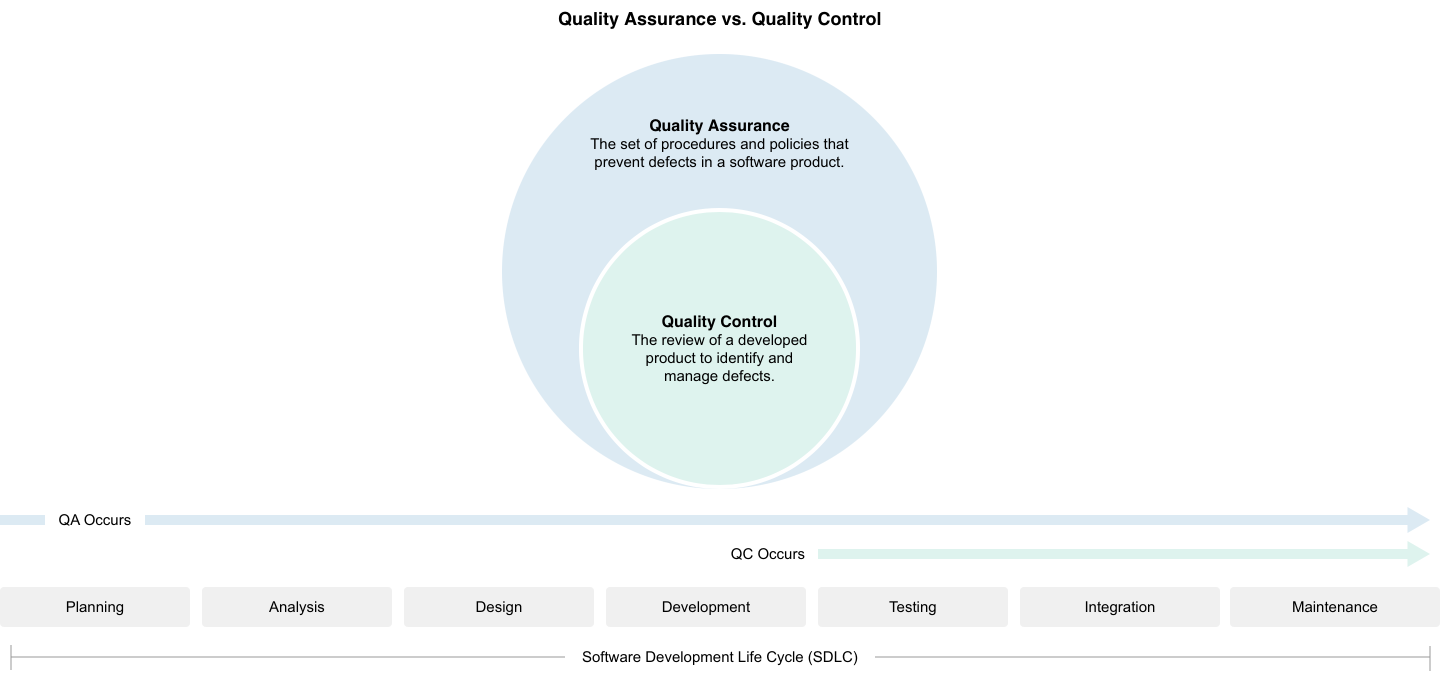
Quality assurance is a subset of quality management. QA involves a set of activities and procedures occurring during product development that helps ensure a high-quality release. QA includes team members from across the software development organization discussing, planning and executing tests to validate product quality.
QA establishes policies and procedures that affect the entire organization. Additionally, QA requires adherence to standards defined by the business as well as any applicable technical standards, such as ISO 25010, or industry standards, such as HIPAA for healthcare organizations. The organization must establish QA policies to ensure every product release meets these standards.
Here are some of the activities that QA helps define:
-
requirements;
-
design and prototyping;
-
programming and code reviews;
-
version control;
-
continuous integration/continuous delivery (CI/CD);
-
configuration management;
-
test planning and execution;
-
release management;
-
deployment and integration;
-
customer acceptance and feedback.
Ultimately, effective QA relies on many moving parts, and it requires diligence and adaptation to meet customer expectations for any product at any given time. What worked yesterday might not work today — that’s why QA must evolve along with product offerings.
Quality control is a subset of QA. In QC, teams ensure that the developed product meets the organization’s quality standards. Defects in a software product, such as UI glitches, design imperfections, accessibility issues or security gaps, can cause irreparable damage to a brand’s reputation. Through a systematic QC process, the organization can correct products to ensure that they meet business requirements and customer expectations.
Digital QC involves a number of tasks, including:
-
identifying product errors or blemishes;
-
testing against quality requirements set forth during planning;
-
ensuring conformance with regulations or industry standards;
-
creating and maintaining test reports;
-
documenting bugs that either must be fixed before product release or can wait until the next iteration;
-
determining areas where quality or the user experience could be improved.
So, what are the similarities and differences between QA and QC? Let’s explore those one by one.
What are the similarities between quality assurance and quality control?
No business wants to release a shoddy product. Businesses across all verticals prioritize customer experience and loyalty. While the two approaches have differences, don’t think of them as competitors, as in “quality assurance vs. quality control” or as mutually exclusive ideas. QA and QC share many of the same goals and objectives.
Both QC and QA:
Ensure a high-quality product. A business can’t simply release a product and hope for the best. QA helps the business strategize for how it will approach digital quality. QC helps ensure the finished product meets expectations. Both QC and QA play vital roles in putting a good product in the hands of customers and securing revenue for the business.
Use policies and procedures. While QA is more process-oriented than QC, both approaches follow standards set by the organization for securing high quality. QC might involve some exploratory, fringe or UX testing techniques that require some creativity on the part of the tester, but defect detection and remediation must still be recorded and executed in an organized manner.
Mitigate major issues and costs. Defects can be minor inconveniences, or massive, business-threatening disruptions. The earlier you can catch a defect, the cheaper and easier it is to fix the problem. As defects move closer to the customer’s hands, the risk increases by orders of magnitude. QA and QC both strive to reduce costs; the former aims to establish policies for early detection, and the latter strives to catch and fix as many bugs as possible in a developed product.
Involve some cost and time investment. Whether you invest internally in QC and QA teams or turn to a testing partner for help, skimping on digital quality could cost your business more in the long run. Invest in the personnel and tools you need to ensure quality across the organization. While release schedules are tight, it’s important to achieve a high level of test coverage. Don’t rush QA and QC.
Improve how the organization makes products. Feedback loops are a familiar idea for developers. Organizations should attempt continuous learning, becoming more efficient and effective with each iteration. QC and QA provide opportunities for the organization to learn where it could improve in areas like bug detection, test automation, requirements gathering and user experience.
What are the differences between quality assurance and quality control?
Confusion over the two terms is common, and there’s even disagreement over which tasks fall under which category. In discussing the differences between quality assurance and quality control, remember that the latter is part of the former, which explains some of the overlap. Still, there are some general takeaways that distinguish QA vs. QC.
QA vs. QC at a glance
|
Quality assurance (QA) |
Quality control (QC) |
|
|
Orientation |
Proactive |
Reactive |
|
Timing |
Throughout the SDLC |
After development |
|
Focus |
All about process |
All about product |
|
Goal |
Prevents defects |
Identifies defects |
|
Scope |
Organization-wide |
Team-wide |
Here are five key differences between QA and QC:
Proactive vs. reactive. QA starts at the very outset of a project, injecting some much-needed guardrails that keep products in scope and make them testable. The goal of QA is to establish a framework to minimize bugs from the beginning, and it even influences how programmers do their work. QA influences how quality will be incorporated and ensured in a product, while QC reacts to the developed product by identifying and either fixing or triaging remaining defects.
When it occurs. As we established, QA occurs throughout the entire software development life cycle (SDLC). QA isn’t a stage in development; it’s a continuous effort to implement, enforce and ensure digital quality. QC, however, can only take place when there is a developed product to test. QC can take place both before and after a product’s initial release.
Process vs. product. One of the primary differentiators in QA vs. QC is where the focus of the work lies. QA primarily focuses on the processes and procedures that improve quality, including training, documentation, monitoring and audits. QC focuses on the product to find defects that remain after development. QC professionals find these issues in a variety of ways, including software testing and beta or canary testing.
Prevent defects, identify defects. Solid development practices — and even quality-forward practices such as test-driven development — can lead to fewer defects making it through to the QC stage, and even fewer reaching customers. QA intends to prevent some defects from ever occurring, through collaboration practices to align teams and methods such as code reviews. Through QC, testers identify and prioritize what defects remain. The emphases are different, but the end goal is the same.
Who does the work. QA is truly an organization-wide effort. If the business side, development side and testing side can’t get together to agree on parameters for software quality, through a framework like Scrum, there will simply be too many defects escaping through to QC. QA helps guide the development of the product so that when it reaches a smaller QC team those individuals will be able to perform their tests with the allotted amount of resources and time.
Maintaining quality from start to finish
While there are elements that divide quality assurance vs. quality control, the two approaches depend on each other to be efficient. Without efficient QA, QC will be inundated with defects, many of which will escape into customers’ hands. Without effective QC, the organization can’t verify that the latest iteration of a product works as intended and is well-received by customers.
QA and QC helps businesses realize a variety of goals that ultimately benefit the business’ bottom line. These two digital quality approaches, when done well, help businesses:
-
create high-quality products;
-
optimize how teams work;
-
improve customer experiences and loyalty;
-
reduce unnecessary costs and wasted efforts;
-
iterate faster and more confidently.
As a global leader in real-world testing services, Applause helps customers every step of the way. Applause can help you establish a QA and QC strategy tailored to your specific geographic and market needs. Applause's global community of over 1.5 million independent experts and end users, spanning more than 200 countries, delivers real-world test results within a scope and timeframe you define. Contact us to begin your journey toward better digital quality assurance.
Quiz
Test Maturity Quiz
Assess your current maturity level and identify strengths and targeted growth areas. Use this quick 10-question assessment to build a roadmap for superior digital quality and faster releases.
Frequently asked questions
What is the main difference between quality assurance and quality control?
QA is proactive and focuses on process, while QC is reactive and focuses on the finished product. QA runs throughout the entire software development life cycle, establishing standards and practices that prevent defects. QC only begins once a product exists to test, identifying and prioritizing the defects that remain before release.
Are QA and QC the same thing?
No. QA and QC are related but distinct disciplines within quality management. QA is organization-wide and process-oriented, covering everything from requirements to release management. QC is a narrower, team-level function focused specifically on testing the developed product against quality standards.
Is quality control part of quality assurance?
Yes. Quality control is a subset of quality assurance. QA establishes the broader framework and standards an organization follows to ensure quality, while QC operates within that framework to test and validate the finished product against those standards.
Does Applause provide digital quality assurance services?
Yes. Applause offers managed digital quality services that support both QA and QC efforts, including functional testing, accessibility testing, payment testing and more. Applause helps organizations build a testing strategy tailored to their specific market and product needs, backed by its real-world testing community.

 9 min
9 min