
The State of Digital Quality in Functional Testing 2026
2026 Annual Report
Learn how engineering and QA teams are adapting in the age of AI to balance speed, quality and expert human judgment
- Identify where they are incorporating AI in their software development and QA processes
- Quantify the impact of AI on digital quality
- Understand key challenges with integrating AI into the SDLC
AI has become ubiquitous – especially within software development and testing. But as organizations integrate new tools and techniques into their workflows, growing pains abound. Teams struggle to adequately test massive volumes of code, determine which tasks are best left to human judgment, and create clear guidelines about when, where and how to use AI in development and QA. This report offers a snapshot of where organizations are on the journey to evolve their development and testing processes and crucial considerations for maintaining quality during this paradigm shift.
AI is Transforming Software Development and Testing
Change is happening fast. In Applause’s 2025 digital quality benchmark survey, 59.6% of respondents reported using AI in the testing process. Just over a year later, that number has risen to over 92%: Only 7.9% of respondents stated that they don’t use AI for any aspect of testing. Our most recent survey attempted to quantify AI’s impact on the way software engineering and testing work gets done.
How much AI has changed development and testing processes
Significant: AI has substantially changed how teams work; the business relies on it heavily
Moderate: AI has helped improve in certain areas, but most haven’t changed
Slight: AI is used on an ad hoc basis but not embedded into processes
None: AI is not used at all in development or test.
Though AI appears to have a slightly larger impact on development than on QA, the margin is slim. The gap may narrow further as AI-powered test automation and LLM-as-judge gain wider adoption.
Top use cases for AI in development
(n=212)
Top use cases for AI in testing
(n=186)
While many teams are turning to AI for test automation, self-healing automation can still be tricky according to Applause CTO Tacita Morway. ”When an automated test fails, it either just stops, or worse yet, an AI-powered system may optimize for completing the task – even if that means changing the test so it passes without actually checking the behavior it was supposed to test. Essentially, it changes its own rules. Safe self-healing automation has to understand the intent of the test, not just the automated steps. With that context, the system can adapt to legitimate changes in the application while avoiding false positives, hallucinations, or gaming its own system just to get to a passing result,” she said.
How Incorporating AI into the SDLC Impacts Digital Quality
While using AI can create speed and efficiency for software teams, it also poses new challenges — some more readily apparent than others. Currently, the ability to create more code faster outpaces most organizations’ capacity to effectively test that code, introducing risk.
New Quality Challenges AI is Creating
Read the Transcript
Since introducing AI into the SDLC, only 26.4% of survey respondents have seen both the number and severity of defects reaching production decrease. Some teams reported no change (and 19.8% said they don’t track that data, which is another problem), while others face higher numbers of issues, more severe issues, or more often, a combination of the two.
AI's Impact on Quality
n=197
“When evaluating AI-powered testing, people often just look for speed. But speed doesn’t tell you whether the tests being created are relevant, reliable, or maintainable.
When AI-powered testing tools are optimized for speed, they can create a whole lot of noise. What separates a useful testing system from one that simply generates more tests quickly, is the depth of testing knowledge it draws from — like industry-specific workflows, testing challenges, and how to find relevant edge cases.
But that context is hard to get — and hard to get right. You need access to a lot of information, and you need to know how to translate it into effective context for the agentic system. The quality of that context ultimately determines the relevance and value of your results.”
Where Human Judgment Remains Crucial
Human involvement in functional testing remains extremely important for 86.1% of respondents, with an additional 13.4% considering it somewhat important. Fewer than 1% believe human involvement is not at all important in functional testing.
Provide qualitative feedback and mentorship through peer review
Design test strategies based on real-world user behavior
Verify AI-generated code against complex business logic and intent
Apply domain expertise to contextualize code reviews
Evaluate the emotional and practical user experience (UX)
Apply critical thinking to investigate and resolve AI-flagged anomalies
Uncover edge cases via exploratory testing
Catch unwritten "common sense" errors that automated tests miss
n=202
While AI has been touted as a force multiplier, it’s not a magic bullet. To get the most benefit, software organizations must find ways to create more intelligent, efficient testing methodologies to validate the tsunamis of code AI can generate, while incorporating human judgment at critical points to reduce risk and create better, smarter QA.
Report Methodology
In August 2026, Applause conducted a survey of members of the uTest community as well as other software development, QA, product, AI and data science professionals, with the following goals:
We also conducted interviews with technology leaders.
Explore Additional Digital Quality Insights

BLOG
How AI is Changing Software Development and Testing
Read the highlights from Applause’s 2026 State of Digital Quality in Functional Testing report.
EBOOK
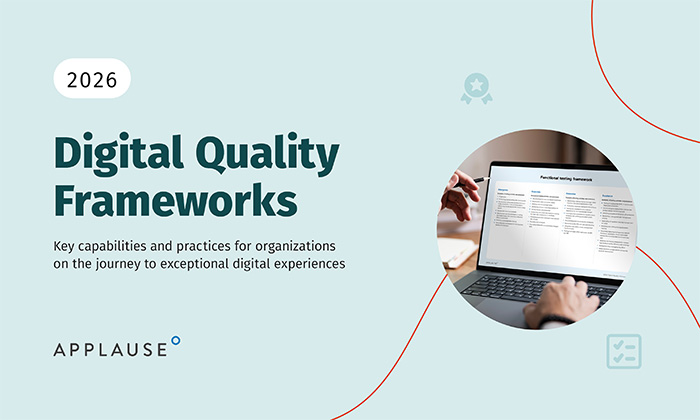
Digital Quality Best Practice Frameworks 2026
Get concrete guidance on how to improve your QA processes based on your current capabilities across functional testing, accessibility, UX, payments, and AI evaluation.

WEBINAR
Ready for What's Next in Software Quality?
Learn the critical elements for a comprehensive AI testing plan. Experts share how to blend AI, automation, and human testing for the best outcomes.