

Select Page

Checklist to Shift Your Testing Left

When companies shift testing to the left, their teams gain the ability to catch bugs earlier in the SDLC. Quality gates ingrained sooner increase coverage and bugs are less likely to reach your customers. A bug found at the end of the SDLC can cost 100 times what it costs if found earlier in the process.

With shift-left testing enabling increased development speeds, your teams can support CI/CD, stay ahead of the competition by launching new features more frequently, and encounter fewer problems at release. Go
through our checklist to see if your internal QA process is using shift-left practices — or if you have room for improvement.
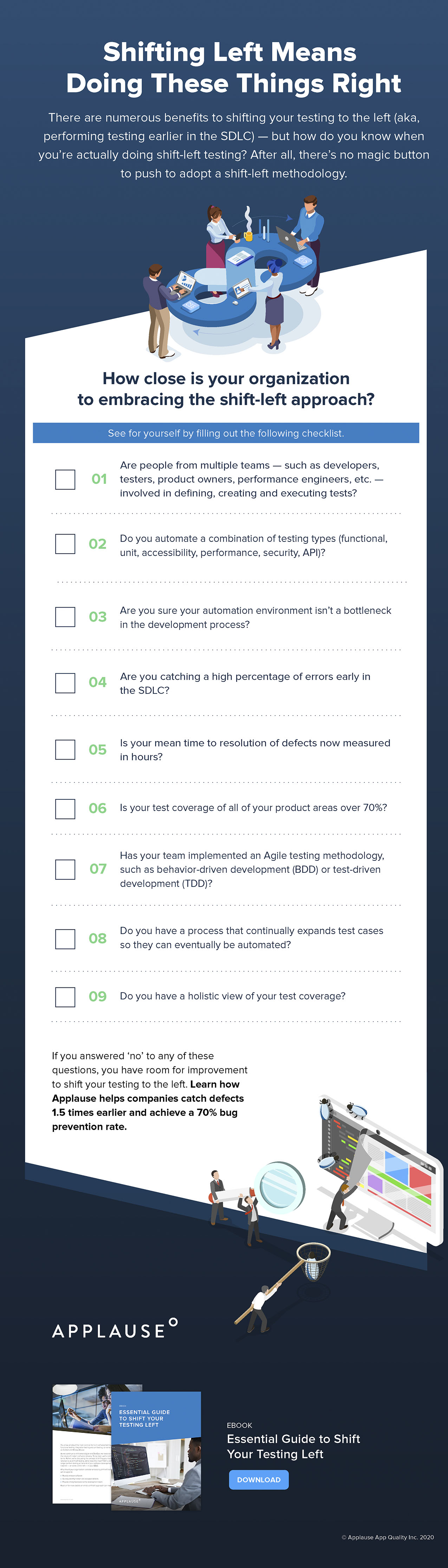
Shift Left to Achieve Superior Digital Quality

In-depth infographic on the importance of shifting left. Click the image to view the PDF.

Want to see more like this?
Marina Lucier
Marina Lucier
Marketing Associate
Published On: April 28, 2020
Reading Time: 1 min

How Much Testing Is Enough?

Risk-based testing prioritizes critical tests to reduce risk.

Are AI Tools Improving Accessibility in 2026?

Read the highlights from Applause’s annual survey on the State of Digital Accessibility.

Human Testing vs. AI Testing: What Each Can (and Can’t) Catch

Find the perfect balance for reliable software testing.

From Drift to Deflection: Engineering Trust in AI Systems

Maintaining user trust in your AI chatbots is a continuous process, involving evaluation, observation and adversarial testing.

Test Automation, AI and Gaps in Digital Quality

While AI-generated code and automation can speed releases, they require human oversight to make sure you’re testing what really matters.

What Makes a QA Process Mature?

Mature QA moves from reactive defect-chasing to proactive quality engineering.
No results found.