

Digital Accessibility in 2024: Some Progress, Some Plateaus
Applause’s fourth annual survey on digital accessibility efforts found that while the number of organizations prioritizing accessibility has grown, teams often lack sufficient resources to be able to release fully inclusive websites and applications. This year’s survey included responses from more than 3,500 participants who work in software development, QA, product, DevOps, marketing, legal, and CX/UX worldwide.
More than 85% of this year’s respondents agreed or strongly agreed that digital accessibility is a higher priority for their organizations this year than it was last year, up from 69% who shared those sentiments in the 2023 survey. Though 42% cited digital accessibility as a top priority for their organization, over a third (34%) report there are no processes in place to stop the release of inaccessible features into production.
Expertise and ownership are on the rise.
In this year’s survey, 77% stated that there is a group or person at their organization responsible for ensuring products are accessible, a significant improvement from the 52% reporting a dedicated accessibility owner in 2023. In addition, 87% said that the team or expert responsible for accessibility within the organization uses inclusive design principles, up from 80% in the two previous surveys.
The number of respondents claiming advanced (26%) or expert (7%) understanding of digital accessibility increased slightly this year as well, up 5 and 1 percentage points respectively from last year. Product developers are increasingly building accessibility into their design plans at the earliest stages: 79% reported they do so. In addition, 26% of engineers stated that they always write code with accessibility in mind, while another 23% said they do so often.
Insufficient internal resources remain a challenge.
Despite efforts to prioritize digital accessibility and increase knowledge of the subject, 73% of respondents reported that their organizations are not adequately equipped to test for accessibility on an ongoing basis without external help. Just 7% of respondents reported having plenty of in-house expertise and resources, while 19% reported adequate expertise and resources.
More teams are turning to automation to screen for accessibility issues: 50% of respondents said they use automated accessibility tools to identify potential issues, up from 40% in 2023. Manual testing remains a cornerstone of accessibility efforts, however, with 71% reporting that they conduct manual testing to identify potential accessibility issues.
Many organizations that serve customers in Europe report that they’re not as prepared for the EU Accessibility Act (EAA) June 2025 compliance deadline as they’d like. While 32% of respondents say they’re on schedule to meet the deadline, 26% report that they’re somewhat behind and 23% say they have not even started to prepare.
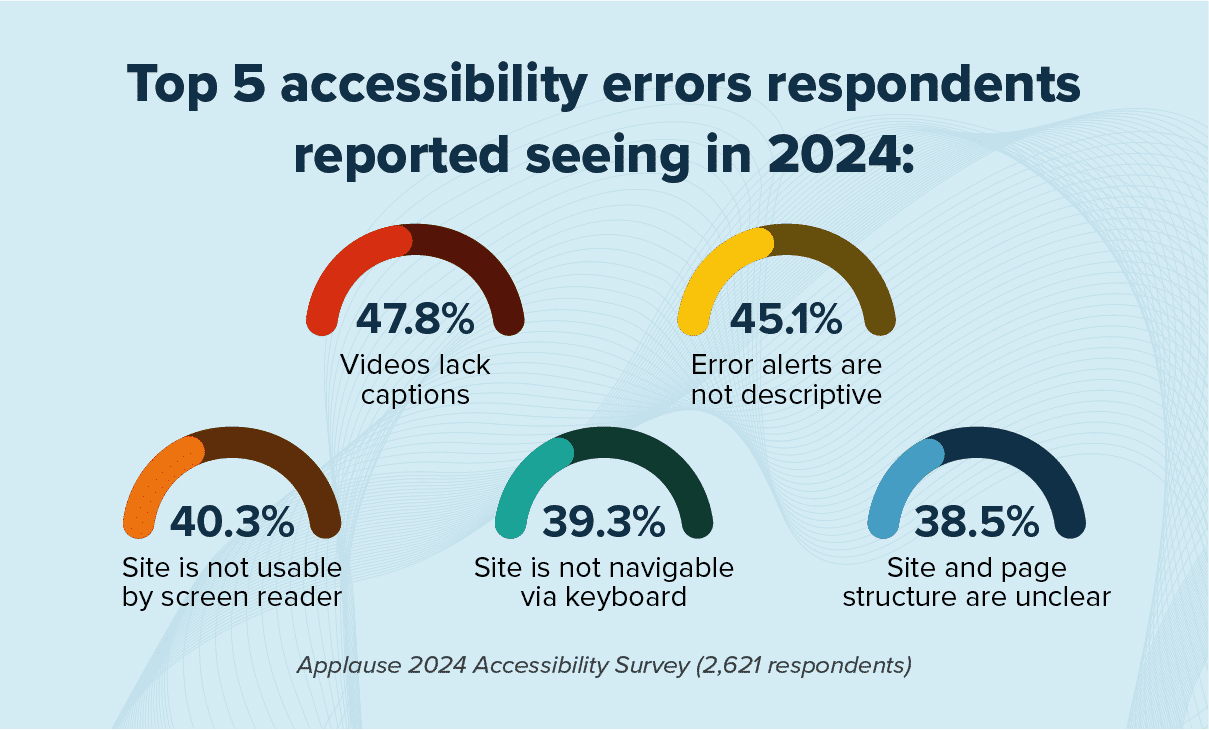
Participants are optimistic about AI’s ability to help with accessibility. Of 2,191 respondents, 60% think AI will provide a significant additive to accessibility testing within the next 2 years. Perhaps AI can assist with some of the most common mistakes survey participants reported seeing developers make:
- Videos lack captions: 47.8%
- Error alerts are not descriptive: 45.1%
- Site is not usable by screen reader: 40.3%
- Site is not navigable via keyboard: 39.3%
- Site and page structure are unclear: 38.5%
The Digital Accessibility Survey is part of the State of Digital Quality content series. In May 2023, Applause released the second annual State of Digital Quality Report, which analyzes a representative sample of testing data and examines the most common flaws in digital experiences in several industries. This year’s report is scheduled for Q3.
Webinar
Empower Everyone: How the Microsoft Power Apps Team Continuously Improves Software Accessibility
Explore how Microsoft Power Apps transforms app development, making technology accessible to all, including those with disabilities. Join our webinar to learn from industry leaders about creating universally accessible applications and embracing the ‘Nothing About Us, Without Us’ philosophy. Gain actionable insights to foster inclusivity in your tech projects.

 4 min
4 min