

What Holiday Shoppers Want in 2022
In October 2022, Applause conducted its annual holiday shopping survey to gather research on retail buying trends. The survey, which included more than 4,700 respondents from across the Americas, EMEA and APAC, revealed some interesting trends in holiday shopping preferences and quality expectations.
Shoppers plan to return to stores, but are curbing holiday spending
One trend the 2022 research shows is a marked increase in plans for consumers to return to shopping in physical store locations since the start of the pandemic. Eighty two percent of consumers said they were comfortable shopping in-store this year, compared to less than half (46%) in 2020 and 69% in 2021.
But despite plans to return to brick and mortar shopping, more than one third (35%) of respondents said they were planning to spend less on holiday shopping this year than in 2021, possibly as a result of uncertain economic conditions.
Mobile shopping continues growth trajectory for second year as most popular online shopping method
In addition to their in-store shopping plans, 87% of respondents said they are planning to make holiday purchases online.
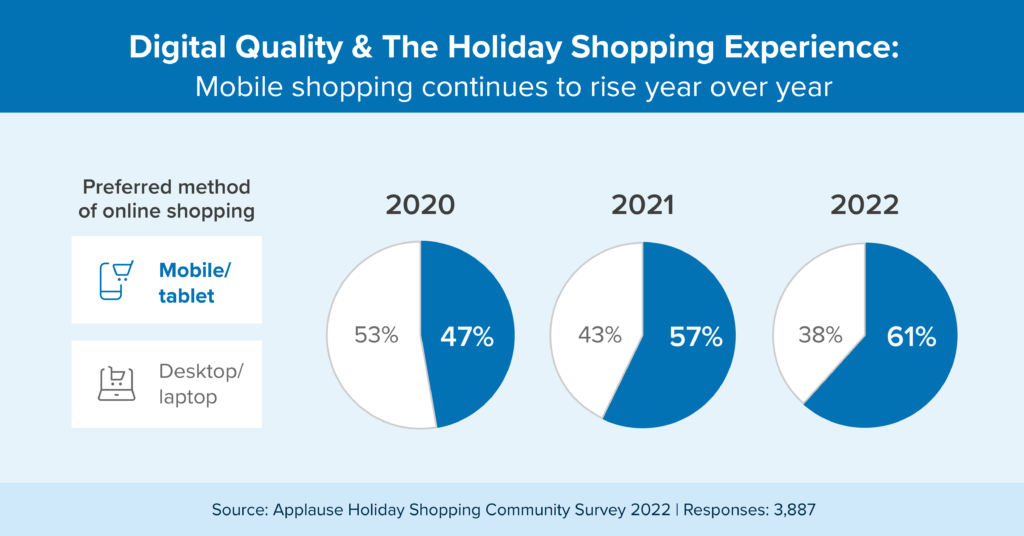
When questioned on their device preferences for online shopping, 61% percent said their preferred method is mobile phone or tablet, a steadily increasing trend over the past three years (57% in 2021 and 47% in 2020).
With this trend in mind, it is important for retailers to consider the vast number of different mobile devices and browsers potentially used for online shopping, and how this may affect the quality of individual shopping experiences.
Price takes a back seat to trust in brand and product reviews
Regardless of shopping preferences and whether or not consumers are worried about curbing spending this holiday season, 62% of respondents said that making purchases with a trusted brand is more important to their online shopping experience than price (32%).
And, for the first time ever, survey respondents said that product reviews were the most important factor (34.8%) in making decisions about purchases. That is a marked increase over 24% in 2021, and 22% in 2020.
Shoppers are likely to abandon flawed digital shopping experiences
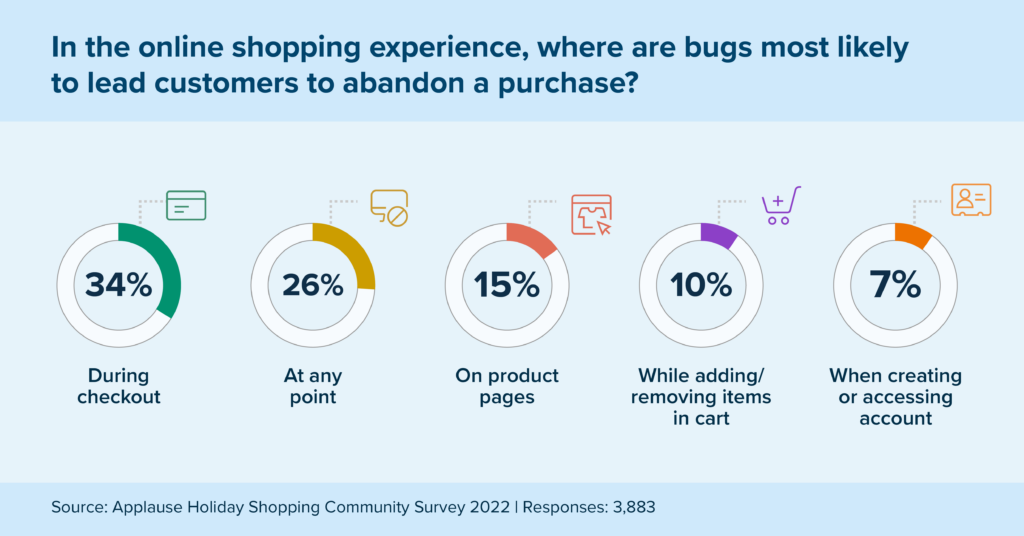
As online and omnichannel shopping has increased in popularity over the past few years, shoppers’ expectations for quality have also become greater. For example, survey respondents said they are most likely to abandon an online purchase during checkout (34%) if they encountered bugs, and 26% said they would abandon a purchase at any point they discovered a bug during the shopping experience.
Additionally, omnichannel experiences like BOPIS (buy online, pick up in-store) and BORIS (buy online, return in-store) continued to grow in popularity since the pandemic. In 2022, 70% of respondents said they have used BOPIS options for holiday shopping, over 58% in 2021.
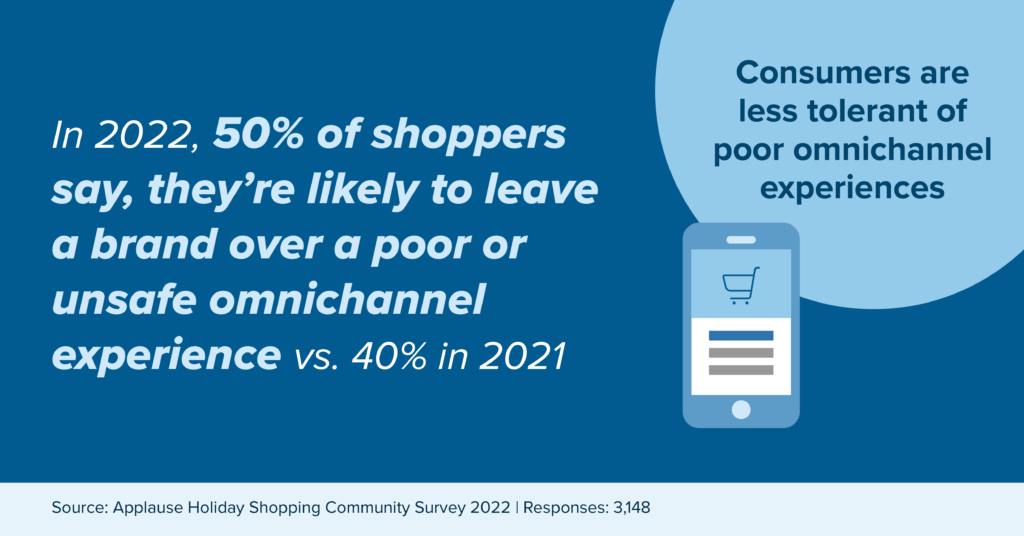
However, as the popularity of omnichannel experiences has increased, shoppers’ tolerance for experiences that don’t meet their expectations has decreased – with 50% saying they were likely to leave a brand over poor or unsafe omnichannel experiences, up from 40% in 2021.
Quality is key to attracting and retaining valued customers
Ultimately, as we see shoppers relying more on product reviews and brand reputation than price when deciding on where they will spend money, it is crucial for brands to focus on providing excellent experiences, both in-store and online. Flaws and friction points can result in shoppers adding brands to the “naughty” list and seeking better options.
And, while it is always important for retailers to make customer experience a priority, this year’s added caveat of economic uncertainty, where consumers are already planning to spend less, should have retailers keeping shoppers’ high expectations for quality at the very top of mind this holiday season.
Learn more about making quality a priority in your retail experiences.

 3 min
3 min